This is a learning note to summarize the CS336 LM from Scratch course (opens in a new tab). I will provde minimal level background knowledge for each topic and implementation for each component.
1. Tokenization: Byte-Pair Encoding (BPE)
Before a model can process text, raw strings must be converted into sequences of integers.
1.1 Why UTF-8? (The Foundation)
The Challenge:
- Characters are complex: There are >150,000 Unicode characters. A vocabulary of this size is too large.
- Bytes are simple: There are only 256 unique bytes. This is a manageable base vocabulary.
1.2 The "Goldilocks" Problem
There is a trade-off in how we split text:
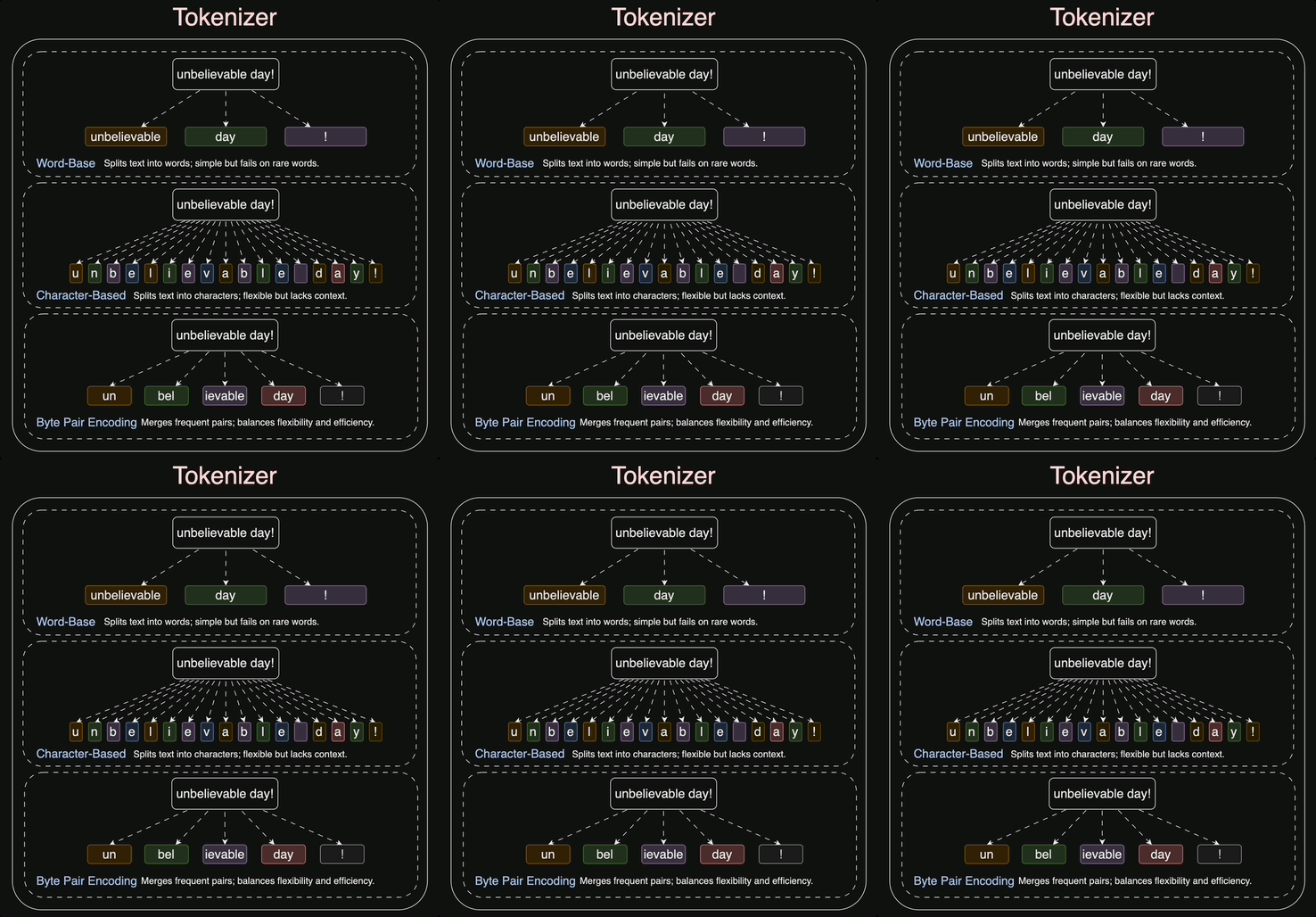
- Character/Byte-level: Vocabulary is small (256), but sequences become incredibly long, making attention computationally expensive (quadratic cost).
- Word-level: Sequences are short, but the vocabulary becomes massive and sparse, leading to many "Unknown" (UNK) tokens.
1.3 The Solution: BPE
Byte-Pair Encoding (BPE) is the standard "middle ground" used by models like GPT-2, Llama, and modern Frontier models.
The Greedy Logic:
- Count all adjacent pairs of tokens in the corpus.
- Pick the single most frequent pair.
- Merge it into a new token.
- Repeat.
Reusing Vocabulary:
- Start with t, h, e
- Merge t+h -> th
- Merge th+e -> the
- Result: Vocabulary contains t, h, e, th, AND the
Tie-Breaking: If two pairs have the same frequency, pick the lexicographically larger one.
1.4 Implementation
def train_bpe(string: str, num_merges: int) -> BPETokenizerParams:
    # Start with the list of bytes of string.
    indices = list(map(int, string.encode("utf-8")))
    merges: dict[tuple[int, int], int] = {}  # index1, index2 => merged index
    vocab: dict[int, bytes] = {x: bytes([x]) for x in range(256)}

    for i in range(num_merges):
        # Count occurrences of each pair of tokens
        counts = defaultdict(int)
        for index1, index2 in zip(indices, indices[1:]):
            counts[(index1, index2)] += 1

        if not counts:
            break

        # Find the most common pair.
        pair = max(counts, key=counts.get)
        index1, index2 = pair

        # Merge that pair.
        new_index = 256 + i
        merges[pair] = new_index
        vocab[new_index] = vocab[index1] + vocab[index2]
        indices = merge(indices, pair, new_index)

    return BPETokenizerParams(vocab=vocab, merges=merges)
A full self-contained implementation can be found in train_bpe.py (opens in a new tab).
1.5 The Encoding Process (Deterministic Replay)
How does BPE tokenize a new string? It does not search for the longest match. It replays the training history.
The Rule: Encoding means iterating through the merges dict (not vocab) in order. For each merge (a, b) -> c, check if a is adjacent to b in the current sequence. If yes, replace them with c.
mergesvsvocab:
merges:{(t, h): 256, (th, e): 257, ...}— Used during encoding to know which pairs to merge.vocab:{256: b'th', 257: b'the', ...}— Used during decoding to convert tokens back to bytes.
Example 1: Assume merge order: (1) t+h->th, (2) th+e->the
- Input:
[t, h, e] - Check Merge #1: Is
(t, h)in merges AND adjacent? Yes ->[th, e] - Check Merge #2: Is
(th, e)in merges AND adjacent? Yes ->[the]
Example 2 (Different merge order): Assume: (1) h+e->he, (2) t+h->th
- Input:
[t, h, e] - Check Merge #1: Is
(h, e)in merges AND adjacent? Yes ->[t, he] - Check Merge #2: Is
(t, h)in merges AND adjacent? No (h was consumed) ->[t, he]
The final tokenization depends strictly on the merge order, not which subword is "longest."
- Byte-Level BPE: We encode text into UTF-8 bytes (opens in a new tab) first. This ensures the base vocabulary is always size 256, and every possible string can be encoded without UNK tokens.
- Special Tokens: Control tokens like
<|endoftext>are added to the vocabulary manually and prevented from being merged with regular text during BPE training.
UTF-8 Prefix Code Guarantee: UTF-8 is a variable-width encoding that guarantees unique, unambiguous decoding using bit prefixes.
UTF-8 Byte Type Reference:
Byte Type Binary Prefix Meaning ASCII 0xxxxxxx A standalone character (e.g., a, 9). Start Byte 110xxxxx Start of a 2-byte character. Start Byte 1110xxxx Start of a 3-byte character (e.g., Japanese). Continuation 10xxxxxx Part of a sequence; never a start.